Showing posts with label Bangladesh. Show all posts

Saturday, October 18, 2014

Bangladeshi storm

I love a good Bangladeshi storm. The boom in the air! The sense of awe in the power of a lightning strike. The chaotic, swirling build-up. The stifling, oppressive air. The darkness.

I love the feeling after the storm has passed; the air now lighter and purer. It smells fresher. Everything is calm and rejuvenated.

The life of the Bengali people, physically or spiritually is consistently inundated by the monsoon rain. During the monsoon a Bengali heart resonates with the water deluge, and mine started as well.

Bring it on, I think. Rage as you will. We’ll breathe easier when you’ve finished raging.


Oreo, the diplodog is terrified of storms. Always sensitive to sound, he cannot take the claps of thunder here. His anxiety has swollen now that to the extent that during one of the nights I rolled over and found him on my pillow. He never ever climbs higher than my feet. But now it's different, he just wants to escape from something that is everywhere.

Saturday, April 19, 2014

Dhaka's black mirror, the Buriganga river

The Buriganga river is the main lifeline of Dhaka. Once the main source of drinking water for Dhaka residents, these days is confronted with foul smells and rotting fish caused by massive pollution. Tens of thousands tons of tannery waste flows freely into the river daily, along with sewage from Dhaka.

The water of the Buriganga is black. The smell is overpowering. Massive industry lines the river; along with the hulls of ships that look they were destroyed in combat, or just driven into retirement by overuse. Small dingy laden with passengers scurry across the river, hand propelled by the river equivalent of a rickshaw puller.There is garbage everywhere on the shores and in the water. It is a testament to the tenacity of plants that vegetation manages to grow here, but somehow it does next to the discarded bottles, toiletries, and occasionally, human corpses. Alongside the edges of the black river are people bathing in the filth, sometimes even brushing their teeth with the rotten river water. No amount of education could change their behavior; these people simply do not have access to clean water. It’s no wonder there are so many sick people in Dhaka at all times. Overall, the sights here look like a depiction of the end of the world; the river is irreparably dead, and a harbinger for what the world could look like one day if we forget to tread lightly.

It goes to show that it doesn't matter how high "a rising tide lifts all ships" if the water looks like it might burst into flame at the drop of a match.


Friday, April 18, 2014

Top 5 cons of living in Dhaka

All right, all right, not everything is awesome here in Dhaka. Without being negative, I am trying to go thru the top 5 irritants.

1) Traffic and drivers

Yep, there is no nice way to put this: traffic here sucks. We’re lucky enough to live close to everything, so we can walk most places, but traffic here is a pain. On the bright side, if you do get into an accident it’s unlikely that it’ll be serious (you’re never going much more than 25 km per hour after all).

Bangladeshis make for horrible drivers. They are the nicest people on earth, but I don’t know what gets into them once they’re behind the wheel.

Traffic and drivers here make me angry, and I had to give up driving when I found myself it saying out loud “I HATE THIS COUNTRY!”

2) The Rickshaws

They are so exotic at first, and I thought they added so much character to the city! But after a while you get rickshawed out. You start seeing how badly they drive, how they stop in the middle of the road to drop/pick up passengers and clog up roads all the time, making bad traffic even worse. I know, I know, lots of people depend on them to get around, but I just wish I live to see this country making the leap to a developed stage and the rickshaws being as rare as they are in Tokyo.


3) Inefficiency

You know the Asian efficiency you hear so much about? Well, that doesn’t exist here. Blame it on the English colonial past, or if you would like, blame it on the Americans, but if there’s an efficient way to get something done, that is not what most Bangladeshis are doing.

And if you’re not convinced of the inefficiency in the city, go to the airport. Oh my gosh, the lines! It takes forever to go thru immigration and retrieve your luggage. And do not forget, we get to go through the diplomatic line at immigration. I can’t even imagine how long it would take if we had to thru the regular line.

And your luggage? It will easily take almost an hour to show up. You know when the belt gets full, in other airports there are handlers picking up the luggage putting on the side to make space to the other luggage that’s arriving? Not here. They will stop loading the belt instead until there’s more space, then the machinery will kick in again. It’s a very frustrating process.

4) “No problem, boss”

If I can never hear the sentence above again, it won’t be too soon. For the foreigner being told “No problem, boss” it means that there is a potentially really big issue.

5) The crowds, poverty and contrast between rich & poor

Poverty here is heartbreaking, the rich are filthy rich and seeing that on a day to day basis really gets to you.

Anyway, enough about the cons. There are more, of course, like the pollution, the dirt, the public urination, but there are many other pros too that I didn’t talk about, so we’ll leave it at that.

Saturday, March 29, 2014

T20 Cricket World Cup

What’s the news in Bangladesh this spring?

CRICKET!!!!!

Bangladesh is hosting the 2014 T20 Cricket World Cup, and they couldn’t be more excited. It’s the second international sports tournament held here this year and the fact that the International Cricket Board allowed the country to host two major events after the political turmoil the country witnessed last year is a really big deal. Dhaka has been s
piffed up to accommodate tourists and reporters.


Don’t ask me to explain the actual game yet. I am a naturalized American, and it was not cool for me to even understand baseball, let alone cricket. But I am making a conscious effort now, as I do want to understand the Bengali soul. And you can't truly understand Bangladesh unless at least you attempt to understand cricket.

Cricket is a source of national pride. Well, not so much these days, as the Tigers (that's the nickname for the national team) are not doing that great. Cricket could also be a source of national madness. If you have a blackout during a game, you could have a riot on your hand. It did happened during the Football World Cup Soccer when fans rioted after power cuts interrupted viewing. They stormed local power offices and attacked state electricity officials after the power supply went off during matches.

So, as a lesson learned, the government doesn’t want their citizens to miss out on a second of the cricket action. So, during the last World Cup Bangladesh co-hosted, they shut down the manufacturing sector on game nights so the reduction in power usage by factories enabled all the TVs in Dhaka to keep working.

The ABC School

There's an old saying, usually attributed to Confucius, that goes something like "Give a man a fish, and you'll feed him for a day. Teach a man to fish, and you've fed him for a lifetime."

I would translate it conceptually into something like "Education is the most important thing you can give someone to increase his opportunities."

Eglal’s ABC School is an extension of the work begun by a teacher of the American International School, Dhaka (AIS/D). Eglal gave lunch to a wandering ‘street boy’ one day at her home and asked him to come every noon. The boy started bringing his friends with him. Very soon, Eglal was feeding about one 100 children every day. She also provided them with their emergency medical needs. Nowadays, over 120 slum kids eat and get an education every day. How is that for a ray of hope?

What my children are taking for granted, here in the slums of Dhaka is perceived as a privilege. These kids are the lucky ones that, once they get admitted, will receive a bilingual education. And there is more to support that: free health care, free lunch, daily showers, uniforms, and mentoring.


I have never been too big on charity. Part of it was maybe because as a number guys I would have a good understanding on how much out a dollar goes to cover overhead cost. But here, all money goes to the school. There are volunteer board members and volunteer teachers. The donations go directly to the education and welfare of the kids. And visiting the school allows you to see how little money it takes to provide for a healthy child.

One kid I spoke to told me that he WILL go on to university. That was probably unimaginable for anybody in his family, not that long time ago. How awesome is that?


We left wishing we could give all of the kids everything they wanted and promising ourselves to find a way to make a difference while in Bangladesh. The need is so great here!

Thursday, March 27, 2014

Spring is here

All of a sudden, spring arrived in Dhaka. And yes,, we’ve been surprised by the change in temperatures. We did not feel it last year, but Bangladesh does have season changes.

The Winter (November thru February) is pleasant for a polar bear like myself. However, it is the most polluted time of year. No rain to dilute the dust and smog. And because of the “cold temperature” (50s at the lowest), people burn anything they can to stay warm. It does not matter what it is, as long as it burns. Anything from leaves to garbage is fair game. Add the exhaust from the traffic congestion and you have a smog blanket of smog that embraces the city. And don't forget the brick factories. They have been underwater during the monsoon and now have to make up for the lost time.


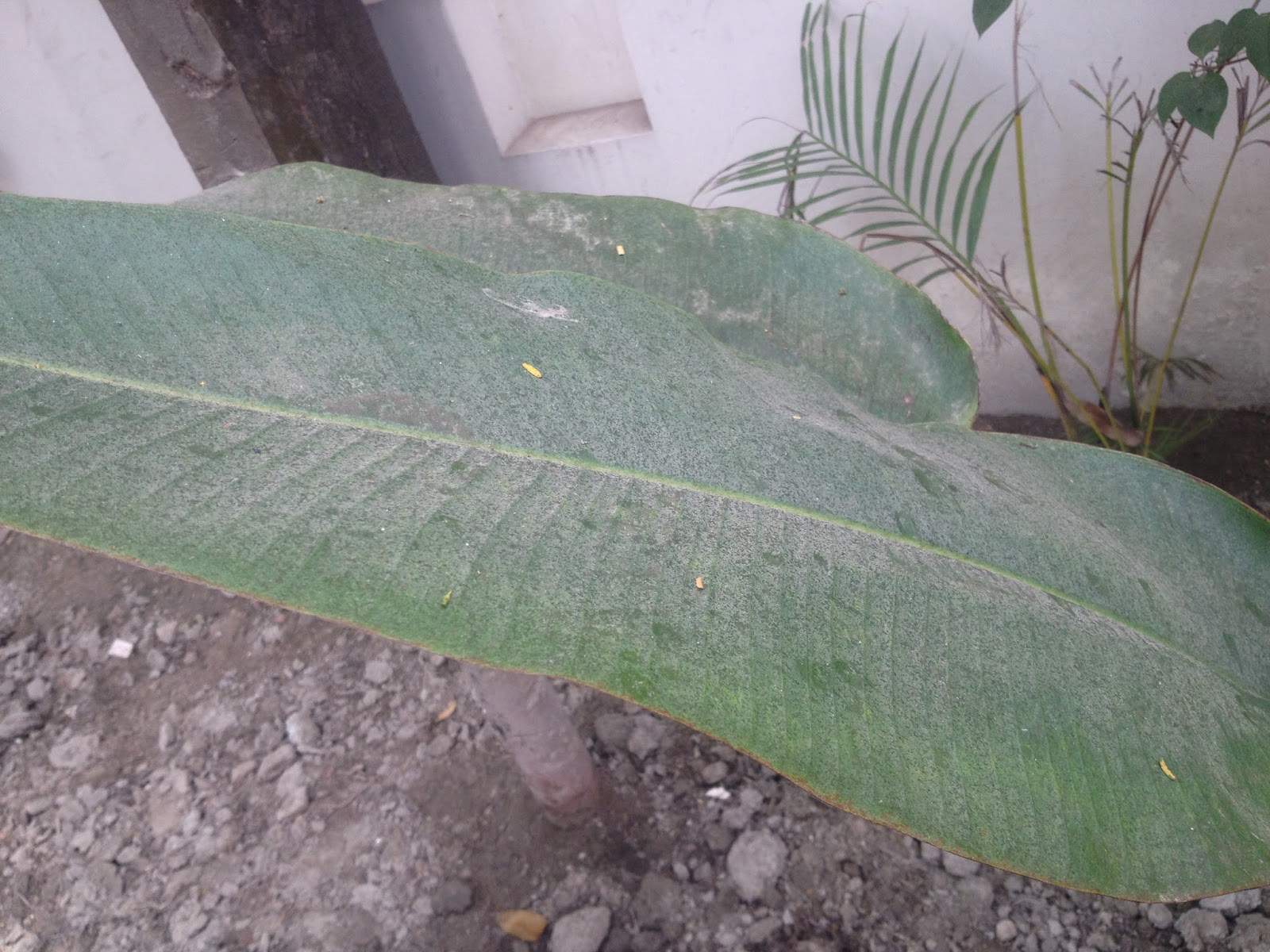
All that pollution comes from the air stay and it settles on any surface. Everything gets filthy. From outside to inside, from flowers and trees to floors and countertops. That's why having a maid here is not a luxury, but a necessity. That's why my lungs feel like I went back to smoking at least a pack a day.

When we landed in Singapore last December, Cristina did not care about the buildings or the gardens. All she would marvel at was the absence of dust. Here is some trees that weathered the winter and are coated in filth.


Friday, February 28, 2014

Beximco visit

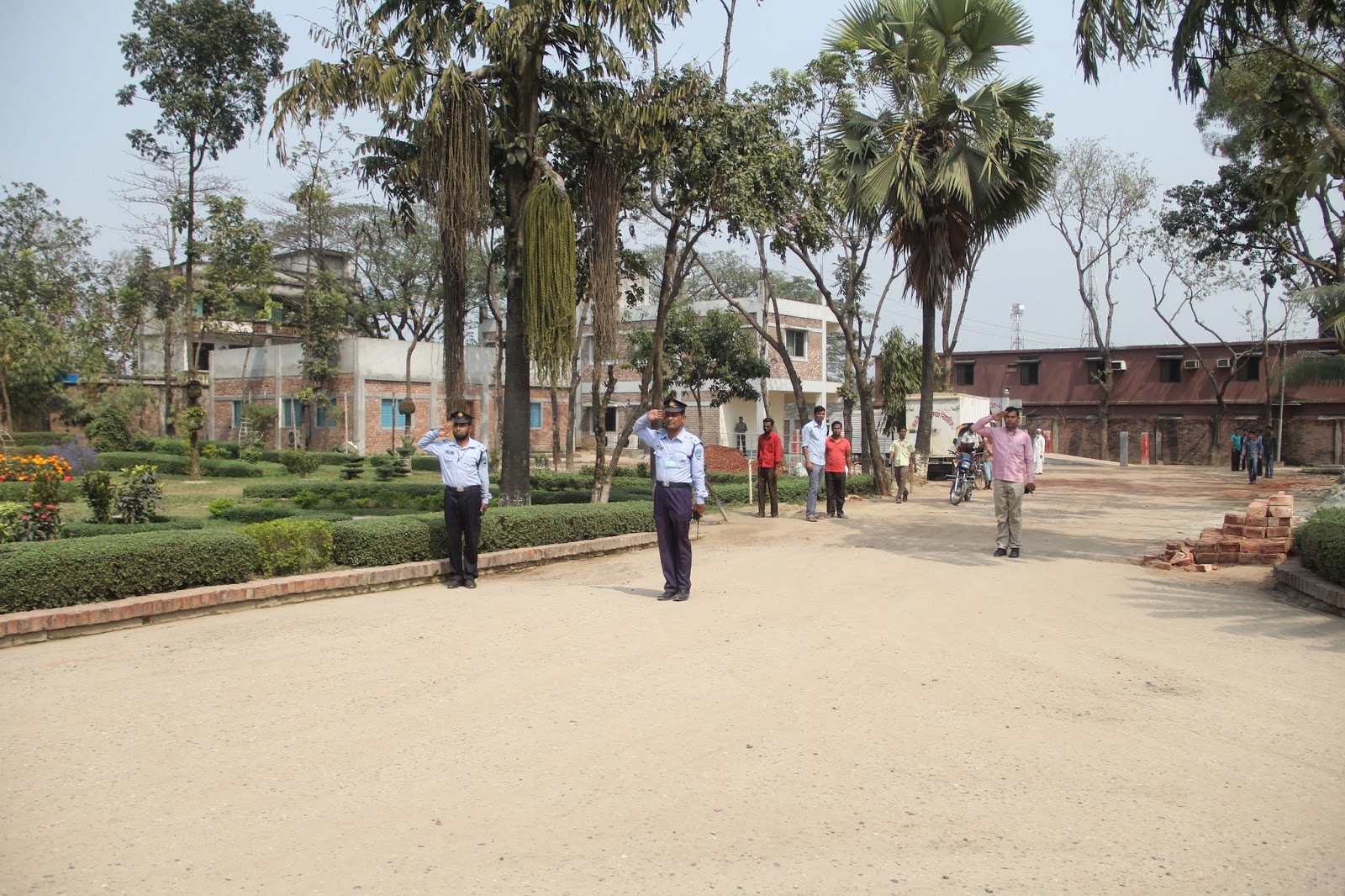
This weekend we had the pleasure of visiting Beximco Industrial Park, the largest private sector group in Bangladesh. The flagship platform now has operations and investments across a wide range of industries including textiles, trading, marine food, real estate development, hospitality, construction, information and communication technologies, media, ceramics, aviation, pharmaceuticals, financial services and energy. The Group sells its products and services in the domestic Bangladesh market as well as international markets. BEXIMCO is the largest employer in the private sector in Bangladesh and employs over 48,000 people worldwide. The Group’s global clients include some of the world’s best known brands including BT, BASF, Chevron, Calvin Klein, H&M, JC Penney, Macys, Zara, UNICEF, Royal Doulton and Villeroy & Boch.

We drove out to their Gazipur industrial park to take a look around and learn about their huge operation. Fascinating day! We toured their garments factories and also visited their Shinepukur ceramics as well.

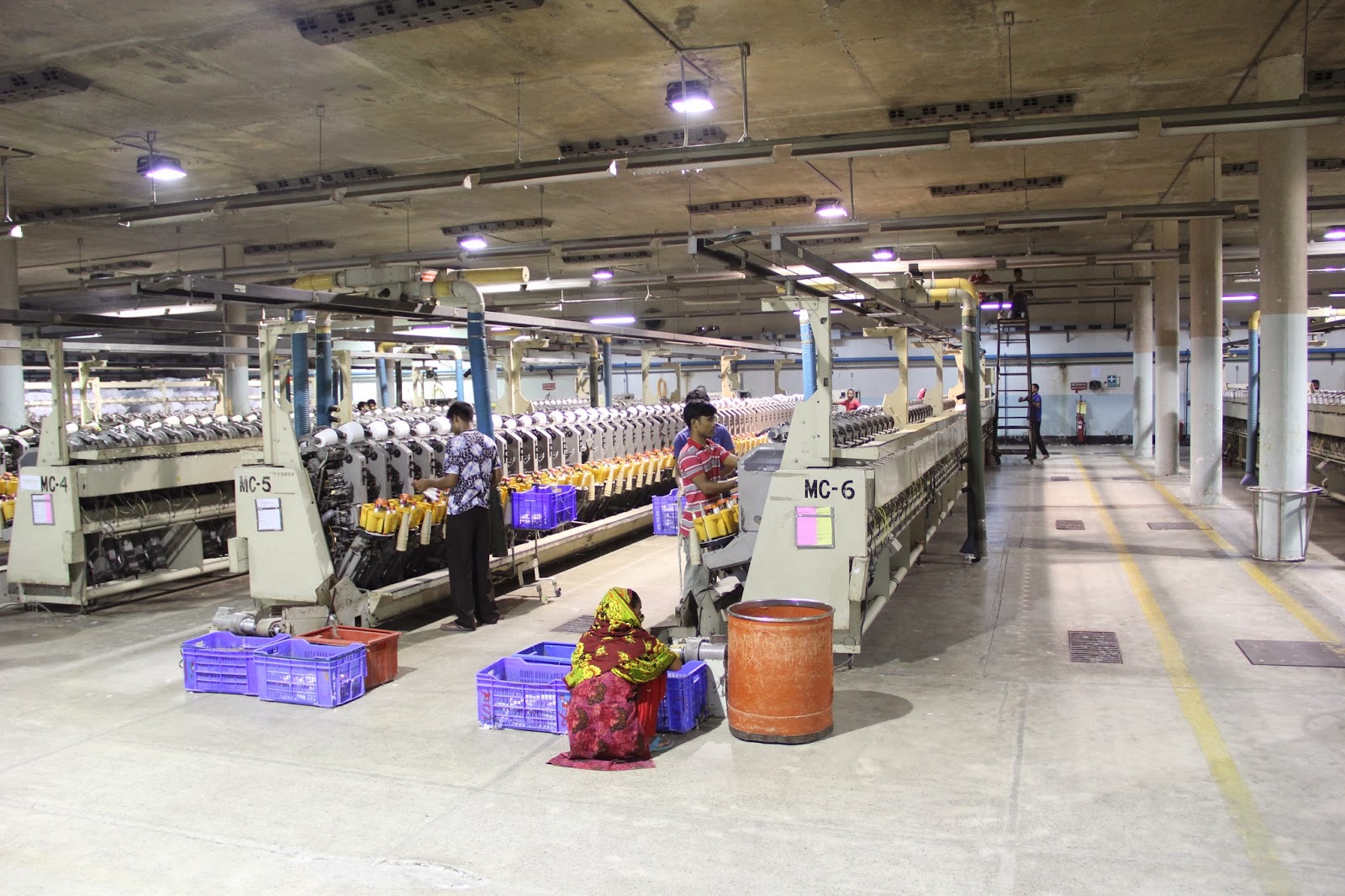
Beximco textiles is unique because it is a fully vertically-integrated production. Most Bangladeshi factories purchase their fabric abroad and just assemble the garments here to advantage of the low labor costs. Beximco, on the other hand, starts with just cotton, and does all their own spinning, dying, weaving, and garment assembly.


We saw lots of machine things, that did lots of cool things, from spinning to the weaving to dying and such. Process was highly automated and high-tech with very few people working for them.