Showing posts with label Baridhara. Show all posts

Tuesday, June 4, 2013

To bleach or not to bleach, that is the question!

A question that comes up every single time in the Desh: to bleach or not to bleach your fruits and vegetables? They might have been washed or irrigated with water contaminated with animal manure or human sewage.


We hate to do this, as some of the fruits and vegetables look so fresh and delicious, and trying to decide whether or not to soak them in bleach is a little painful.

If we do bleach, do we use boiled water or regular tap water with some bleach mixed in? I mean, bleach should kill everything, right? Can we just rinse them in the boiled water? And if we do use boiled water and bleach, what happens when you eat in a restaurant that doesn't take the time to boil/bleach?

Ok, maybe we are still confused or scared about this bleaching thing, but I’m feeling confident that one solution to the water problem is to drink generous amounts of alcohol! After all, all these Bangladeshi viruses and bacteria know nothing about these evil Western liquors.

Wednesday, May 22, 2013

So you got to let me know, Should I stay or should I GO?

King George II of Great Britain died while on his and according to statistics, we each spend an average of three years of our lives sitting on them.  And  2.5 billion people worldwide still do not have access to one.


Yes, it is about the TOILETS and access to one of them. Half of Bangladesh's 160 million people have no access to a toilet at home. You can notice that in the streets of Dhaka all the time. To many Bangladeshis, a toilet is just a concrete platform. Going to the toilet is a matter of practicality.

That is such a contrast with another fact: more then half of Bangladeshis own a cell phone and that became a symbol of the betterment of lives. That is puzzling to me; it means somebody out there has a cell phone, but still is urinating somewhere on the streets!

Mahatma Gandhi, India's greatest leader, had a huge preoccupation with sanitation and toilets. Once he inspected toilets in Gujarat. He found them dark, stinking and reeking with filth and worms in the homes of the wealthy and in a Hindu temple. The homes of the untouchables simply had no toilets. "Latrines are for you big people," an untouchable told Gandhi.

Gandhi seemed to recognize the value of the toilet to humanity when he said "Sanitation is more important than independence." One can only hope that these words will once resonate with today Bangladesh and world leaders.

Saturday, May 18, 2013

Oreo, our diplodog (Part 2)


It is really odd. Dogs are not allowed in parks or gardens in Bangladesh. That is ironic, to say the least, since the parks are full of strays. So, walking them them becomes an issue. There are no sidewalks, or art least not free of debris, so you pretty much have to dodge cars and rickshaws on the dusty roads. On top of it, you really have to be mindful of the strays. Whoever is walking a dog has to be "armed" with a big stick to fend the off. A colleague from the Embassy learned that the hard way, after her dog got bit.
Which brings me to the vet care, or lack of thereof.


Veterinary health care here is pretty much non existent. There are no veterinary clinics, except for a military structure, no x-rays, no analysis, so basically nothing! There are two known veterinarians, one of them an Iranian refugee. He loves animals, and does what he can. Luckily we did not have to try him, I only talked to him on the phone so far.Dr. Siamak, +8801711561155He does home visits, has no real surgery place and does perform small operations at your home.

Grooming saloons? Forget it. Will do it at home.


Walks? Will use the roof top.


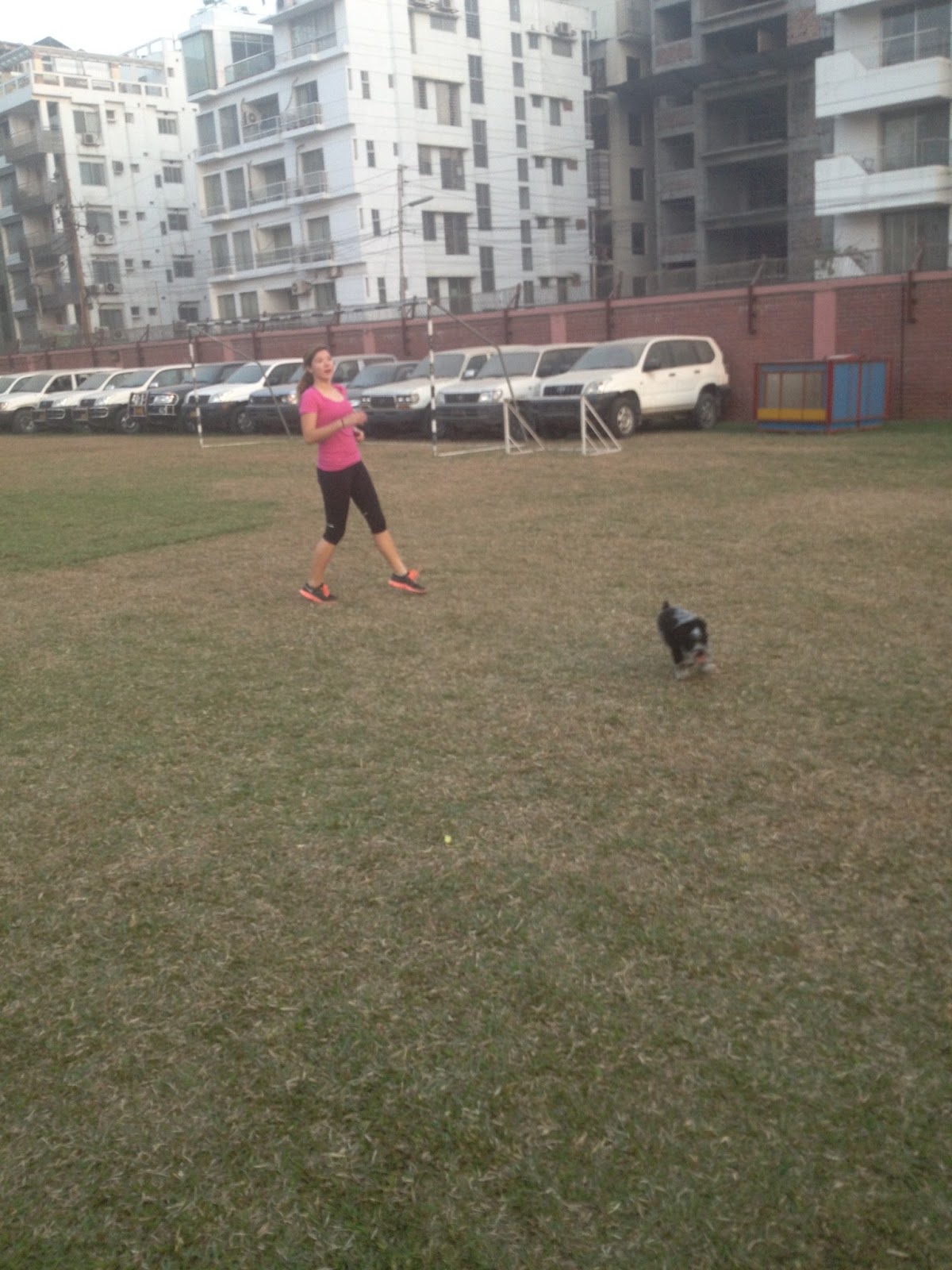
Exercise? Will run with the Marines.


and crash in bed soon after!


Tuesday, May 7, 2013

The call of the call

It started with our first night we spent in Dhaka. We were able to beat the jet lag and fall soundly asleep. Then around 5.30 it hit us. 

The early morning call to prayer - a sort of Islamic vocal wake-up call to the nation - is really something to hear and we now well understand its power. It starts with a single call and then waves of sound emerge from everywhere in the city, melodious and harmonious though not in unison, increasing in intensity and power as every muezzin in the city sings his call to the faithful. It is not like you hear the loudspeakers from just a few mosques. It feels like  from thousands of buildings, a local singer alerts the Muslims of the city to their duty. Waves of sound roll across the city like surf.

Now being located close to the central mosque in Baridhara means we are in direct 'firing' line for all the call to prayers - yes there are more than one and depending on which mosque it could range from four to seven.

Thankfully the call is short and now after we got used to it and can go back to sleep. Because shortly after it is finished, the crows take over. The most prominent sound in the day from our windows is that of crows, hundreds of them.

Wednesday, May 1, 2013

Dressing down in Bangladesh

The country has been engulfed in endless political protests. Meanwhile, a demonstration of a different kind took place over a ban on rickshaw drivers wearing a traditional garment that is worn by millions throughout the country.

Crowds of young Bangladeshis filled the streets of Dhaka three weeks ago wearing colorful lungi to protest the ban on the dress in our diplomatic enclave, Baridhara.

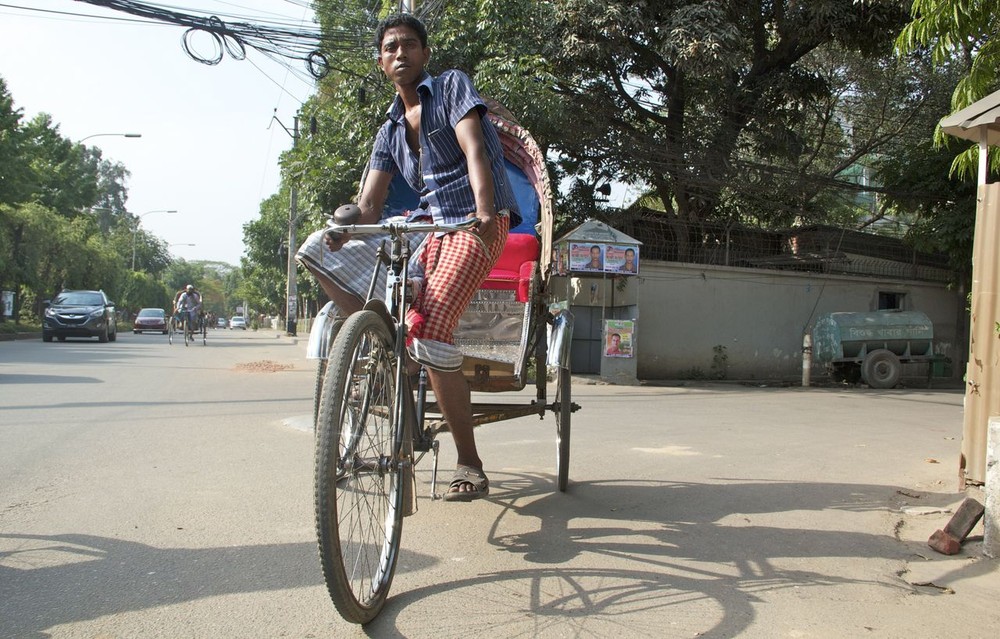
Vlad and I witnessed the ban first hand when our favorite rickshaw driver, Babu was pulled over and not allowed into Baridhara because he was wearing a lungi. We fought with the police officer and managed to somehow get him instead. We ended up inviting him for dinner and Vlad donated him some of his clothes which amazingly were the right size.


Anyway, about 400 marchers protested the recent ban on rickshaw drivers from wearing the lungi in Baridhara. Most of them wore the traditional lungi. The peaceful rally was announced on Facebook just days after the chairman of the Baridhara housing association, said only rickshaw pullers wearing trousers would be allowed to work the area.
Lungi are in some circles considered to be worn by the lower class, but is the most commonly worn garment by men in Bangladesh. Even the father of the nation, Sheikh Mujibur Rahman, wore a white lungi often to show his solidarity with the people of his homeland. The ban is even sadder since the average income of a rickshaw-wallah is about $4 a day, excluding rental fees for the rickshaws of around $1 per day.


As the demonstrators marched towards Baridhara chanting "lungi, lungi", they were stopped by dozens of police blocking the entrance with guns and batons in hand. Protesting is not allowed in diplomatic zones, they were reminded by the officers on the scene.