Saturday, April 6, 2013

The Cave Temples of Dambulla

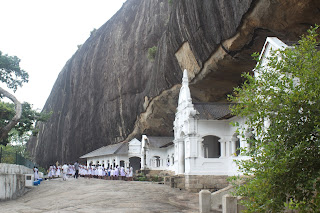
From Sigiriya, we found our way to Dambulla, a busy town close to the Rock. Constructed in the 1st century BC, the cave temple complex is another UNESCO World Heritage Site.


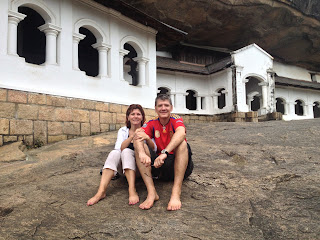
After buying tickets and going around the massive golden Buddha, we found a crowd of monkey gourging on the flowers people brought as offerings. Vlad could not have been happier. He almost got bit by one when he did not release a flower soon enough.


After a steep climb in the forest (with monkeys along the way) we found again incredible stretching all the way to the Lion Rock.

The temple complex has five caves of varying sizes. The caves are shallow, but filled with ancient sculpture and artwork. Hundreds and hundreds of Buddha statues and a mind-blowing collection of murals that cover everything.

The site had been used for shelter long before Sinhalese King Vattagamini Abhaya found refuge here. After having been driven from Anuradhapura by an Indian invasion, he lived in the caves for fifteen years, nursing his wounds and building an army. He returned to the capital and drove out the foreigners. In celebration, he built Dambulla’s Cave Temple at the place of his refuge.
It’s an awesome feeling to be in a dark mountain temple, which looks much as it did over 2200 years ago when a victorious Sinhalese King was celebrating the recovery of his kingdom.


Climbing Sigiriya Rock – The Eighth Wonder of the Ancient World


After a restless night (we needed to be aware of the monkeys) we got up early to be at Sigiriya rock before the heat arrived. We grabbed some breakfast and headed to the Rock! The climb ahead was going to be tough, but we needed this to get ready for the Adams Peak later.


The story of the Rock is fascinating! 
Prince Kassapa knew his half-brother Moggallana was going to inherit his father's throne. Not willing to accept this,  in 473 AD he murdered his father by burying him alive and took over the kingdom. Prince Moggallan fled to India, leaving the Kingdom of in the hands of Kassapa. Kassapa lived in fear of his brother’s and decided to move his royal city to a safer. He found the place on the top of Sigiriya Rock. Construction lasted seven years. Stairs were cut into the rock, and materials required for his palace were brought up piece by piece. In front of the rock, a breathtaking pleasure garden was installed. Moggallan returned in 491, and somehow managed to get Kassapa to come down from the rock and lead his men into battle. When Kassapa’s elephant reached unsteady earth, it began to back up. The King’s men assumed that he had lost his nerve and retreated for the safety of the rock, leaving Kassapa alone. Seeing that his fate was sealed, Kassapa killed himself with his sword.

Nature’s awesome beauty and the ingenuity of mankind come together majestically at Sigiriya Rock. A massive 320-meter granite stone set incomprehensibly in the jungle, the “Lion Rock” was attracting admiration long before King Kassapa built his castle on top of it, and continues dropping jaws today.

Sigiriya is one of the top touristic sight in all Sri Lanka, and for good reason. A visit to Sigiriya is unforgettable. And Sri Lanka knows that and charges $30 per foreigner head to enter the site. The locals only pay $0.40. I almost wanted to go back in outrage but swallowed my pride and bought the tickets. I’m glad we did.

After entering the grounds, we were greeted by a marvelously restored 5th century pleasure gardensa. First, a Water Garden with an expansive and complicated set of pools and ponds, and further ahead the King’s Boulder Garden. Here, we saw the Cobra-Hooded Cave. Before Kassapa’s arrival, Buddhist monks had considered Sigiriya a sacred place, and built temples around the base of the rock.


We started our ascent well before the sun was at full strength. This was a wise; we avoided both heat and crowds.

Midway up, we encountered the Mirror Wall and the Hall of Maidens. The rock at the Mirror Wall had been polished smooth and flat and coated with a shiny plaster, so that the King could admire his reflection during his ascent. Today luster is gone and it looks like a stone wall. The fresco gallery, found just above the Mirror Wall is just impressive. The Damsels of Sigiriya are some of the most famous ancient paintings in the world, and they very well conserved.


After the Mirror Wall and damsel gallery, we emerged at a large terrace. We were exhausted and stunned to see that we had only completed about half our journey. Before us, two immense lion paws carved out of the rock indicated the beginning of the ascent’s second half. Under the pretense of admiring the lion, we took take a break before climbing up to the summit.


A massive, 60-foot lion was chiseled out of the rock. The steps which continued up to the royal palace started at the lion’s feet, wrapped around his body and eventually entered his mouth. Today, all that remain are the paws, but they give a good idea of the statue’s scale. It’s hard to appreciate how impressive it must have been 1500 years ago. It would be impressive now.

The final flight of stairs, hugging tightly to the stone wall, is not for those who suffer from vertigo. If we, on these steps of modern steel, were so close to throwing up, how terrifying must they have been during the time of Kassapa?


Once we gained the summit the ascent made perfect sense, as the view is unobstructed for miles around. From the top of Sigiriya, you truly feel at the top of the world. The palace is presently nothing but rubble, but you can easily imagine it must have been an amazing building. You can smell history, and the panoramas over the jungle and gardens below couldn’t be better. The descent promises to be no less dizzying.


We start our descent and at the lion's paws make friends with a bunch of monkeys. Kids get the photo op for a new Facebook cover.


Down at the entrance it's already very crowded. It was good to get up early. Back at the hotel, we take a shower and hit the road.

Tuesday, April 2, 2013

TIB (This Is Bangladesh)!!!


There are only two rules for us, the ‘Bideshis’ (foreigners) here in the ‘Desh’: 

Rule number 1) This is Bangladesh (T.I.B.)

Rule number 2) When in doubt reffer to rule number 1

When we witness something out of our comfort zone or something that really does not make sense, we simply refer back to rule number one. This rule just covers and explains it all.
The traffic, the smells, the rain, the blackouts, and the unpredictability - we take it all in. It is all part of the experience. And this is what makes Dhaka, Dhaka! 

Dude, who poisoned my food?

Adulteration of food with toxic chemicals has reached an epic proportions in Bangladesh. It has been called the ‘silent killer’.

It is almost impossible to find a sector which is free of adulteration. From raw vegetable and fruits to milk and milk products to fish, meat and processed food–every food item is contaminated. Every day I read in the newspapers about a newer method of adulterating foods. Carbide, formalin, textile colours, artificial sweeteners, DDT, urea etc. are used rampantly.

Chemical agents like calcium carbide are randomly being used for ripening different kinds of fruits like banana, mango, papaya, tomato and pineapple and also to keep them fresh.


Most of the red chilli powder used in the market is adulterated - in most cases the spices are mixed with brick dust. Fine sawdust is also often mixed with cumin and other ground spices. Honey is also frequently adulterated, as sugar syrup is often mixed with honey to enhance the sweetness.

Pure butter oil and ghee are also very rare in the market as dishonest traders use a host of ingredients such as animal fat, palm oil, potato mash, and vegetable oil to produce fake butter oil. They even mix soap ingredients like steirian oil with ghee, to increase the proportions.

Condensed milk produced by Bangladeshi manufacturers contains little or no milk and is in fact condensed vegetable fat. Sweetmeat makers unaware of existence of food colouring use only
industrial dyes in their products. Dough makers put sulphuric acid in hot milk to make it thicken quickly.

The chemical fertiliser urea is used in the rice to make it whiter and formaldehyde (used to preserve dead-bodies) is used in fish, meats and fruits to keep them fresh-looking.


In the long run, these chemicals in food adversely affect vital organs such as the liver and kidney resulting in organ failure and/or cancer and thus, untimely loss of life.

Ironically, people are aware of the hazards of taking foods adulterated with toxic chemicals, but this knowledge is not translated into practice. They are still buying and consuming these adulterated foods because of several factors: absence or unavailability of non-adulterated food, appearance, costs, cultural factors, food habits etc.
Occasionally, the authorities will be suddenly in an active mode, and conduct mobile courts to penalize sellers/producers for selling contaminated products/foods. Then, there will be a lull for a few days and after few weeks, business becomes as usual.

The strategy that I came up with is simple, yet far from being bulletproof:

If the flies do not like it, then I won't like it either. If I do not see anything being attracted by the "fresh" meat/fruit/vegetable, there is probably a reason for it.


Monday, April 1, 2013

Our life saver water distiller

Best thing in our new home happens to be our water distiller.

Because Bangladesh happens to be a country with poor civil water quality, we were issued a water distiller that purifies the water you need to drink, brush our teeth, and so on. Our helpful embassy staff also provided us with a water dispenser that has a hot and cold tap.


Our "stiller" gives us the best water we tried so far here. There is a caveat, especially for us who have children: the distiller removes all the impurities, including the fluoride which in the States is added to our water to strengthen the teeth. Therefore, the kids must use fluoride toothpastes.That is a small price to pay then having arsenic in your water, which is the other bad news we got in Bangladesh.
The leading cause of death in this country is arsenic poisoning from ground water contamination. So we got to love our "stiller" and are very grateful for it!

Saturday, March 30, 2013

Betel Chew (Paan)

When we first witnessed people with red stains on their teeth, for sure we thought it was blood and felt compassion for so many people suffering from some sort of gingivitis. Little did we know about the paan.

Paan is a wrap and it’s such a vital part of Bangladesh culture! Many people joke that betel nut is Bengali “chewing gum.” 
Street vendors make it and sell it from little sidewalk stands everywhere throughout Bangladesh as the ideal way to end a meal or tea break.

A green leaf is filled with betel (areca) nut, lime, fennel seeds, cardamom, clove, or other spices; then it is popped into the mouth. The areca nut contains the alkaloid arecoline, which promotes salivation (the saliva is stained red), and is itself a stimulant. When they spit, it looks like they are spitting blood, and sidewalks have red stained spots from it.  As they chew, people enjoy the peppery taste, the warm feeling in their body, the alertness it gives. and very much a social habit amongst the great, bad or good!

Unfortunately, betel nut is not merely a mild stimulant or a non-offensive after-dinner treat. It’s a dangerous carcinogenic snack. Chewing betel nut causes cancer of mouth, esophagus, stomach, prostate, cervix, and lungs. Mouths develop ulcers, and gums deteriorate.


Last night, after enjoying a nice dinner with a couple of our Bangladeshi friends, the urge for paan was felt. I accompanied the driver who went looking for the precious treat out of pure curiosity. Needless to say that, after having witnessed how it is prepared and trying it for a little bit, I think I will stick with my after-dinner sambuca for now!

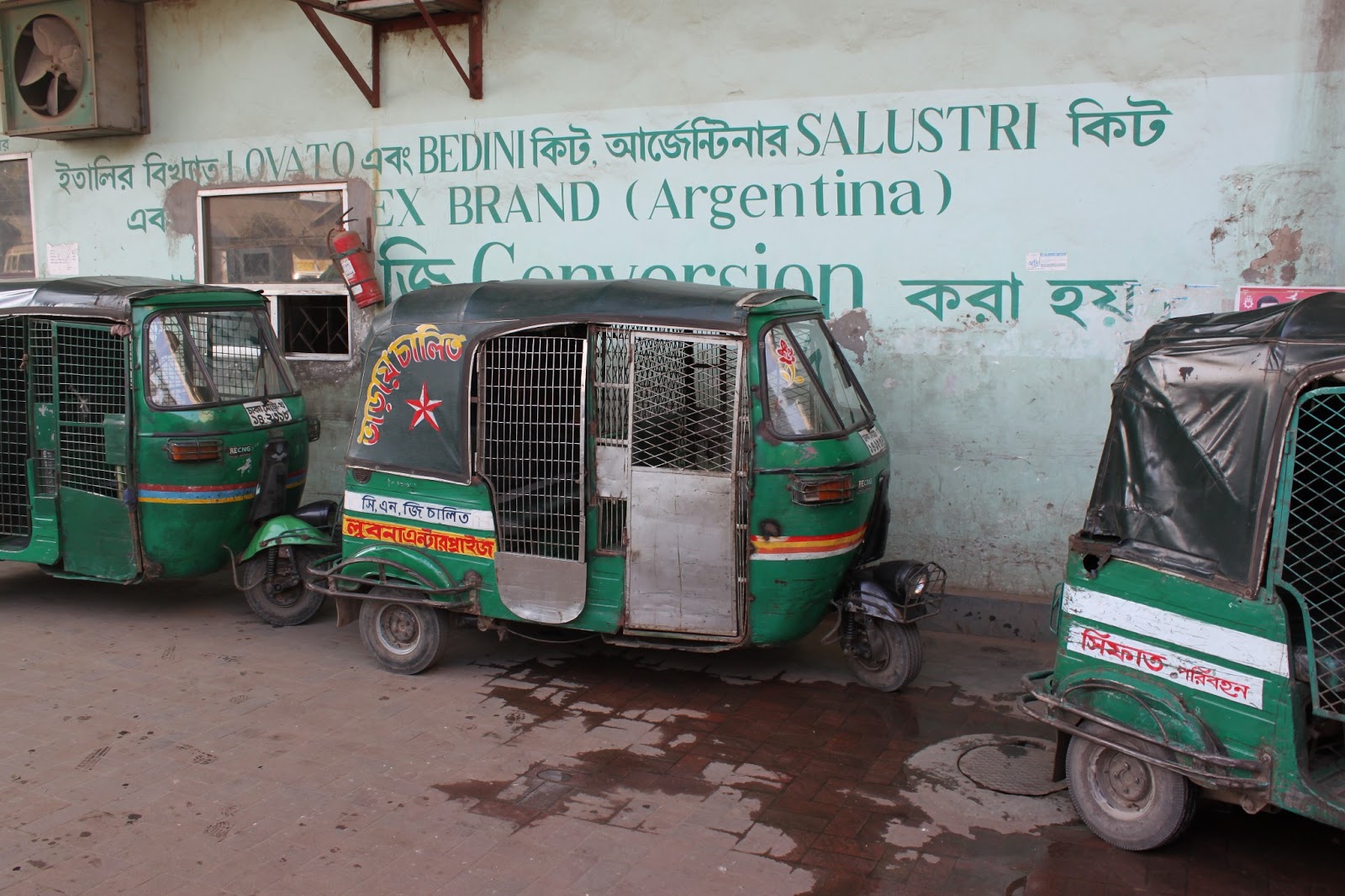
The auto-rickshaws - CNG


It has been two months since we arrived in Dhaka and the novelty of the CNG-powered auto-rickshaw still hasn’t worn off.

CNG, also called baby taxi, are the notorious green auto rickshaws that zoom dangerously around the city like aggravated motorized wasps. You clamber into the back and the driver essentially locks you us in, in what it is basically a cage on wheels. All CNGs were fitted with these cage doors due to crime and bag snatchings. The problem now is that the bad guys approach the cage, lock the door and threaten to throw gas on you and set you on fire. 

Countless beggars take advantage of the regular traffic standstills and approach the CNGs vehicles and are reaching with their fingers in the rickshaw’s cage to grab attention. Some of riders slot taka notes out, which are greedily snatched by the beggars.

Poluttion used much worse in Dhaka (yes, I know, I find that one hard to believe), so the government of Bangladesh took action in the mid-1990s to clear the air. Leaded gasoline, which can pollute groundwater, was banned in 1999. Strict regulations were placed on the sulfur content in diesel fuel. An import ban was placed on two-stroke three-wheelers to help phase out older-model auto-rickshaws, and a widespread CNG program was launched. Compressed natural gas, CNG is known to be a fuel with lower air pollutant emissions and also the country has abundant natural gas reserves. Two-stroke engines were banned completely in 2003. When this happened, there was a 30 to 40 percent drop in pollution in Dhaka.

We have been forbidden to ride into one, because they are deemed unsafe, but they seem to genuinely fun. My local colleagues use them all the time and some of them describe them as dusty, uncomfortable and bumpy, but others appreciate them as expedient, more comfortable and spacious than the bus. And there is also the danger of being mugged as well.
For some, being locked inside the caged compartment reminds them of an amusement park ride. The CNG can also zip thru traffic because they are around two-thirds the width of a car, so they can beat the cars in the traffic jams. Sometime, the ride is taken to another level, some sort of a stunt driving, that Hollywood would probably have something to lear from. It is not unusual to see CNGs driven along the footpath by a driver who doesn't want to wait for a jam to clear up.

The funniest urban legend I heard about a CNG ride was about a couple riding in one without side doors. Suddenly a naked man leaped into their CNG and asked for money. The husband, wishing to see the naked creature promptly disappear, quickly scooped up one 100 taka note. “How can I dress myself with one hundred taka?”. One can easily guess that he got another note right away.


Friday, March 29, 2013

Brother romance (Bro-mance)

One thing that still strikes us in Bangladesh: Men hold hands here all the time. The meaning is completely different then the one we are used to in America. In fact, many Bangladeshis I have talked to don’t believe in homosexuality at all. According to them, it just does not exist. Yet, it’s not uncommon to see a man touching the small of another man’s back here, or resting their hand deep on their friend’s thigh.


My first time I have held hands with a man in Bangladesh, he wanted to have a picture taken with me. We posed for the photo when he grabbed my hand. Instinctively, I flinched and pulled my hand away. But then I turned to him and saw the horror on his face, realizing my mistake. I put my hand back down, let him take it, and then smiled for the camera. 
When in Rome…

And at least, this culture of physical contact between men has provided me with a new hobby; taking pictures of guys in front of me holding hands.

Why's Everybody Always Honking On Me?

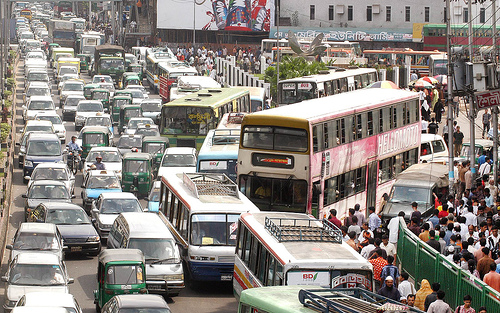
You can always tell the intensity of a Dhaka traffic jam by the decibel level the honking horns have reached. If you can still hear the person next to you speak inside an air conditioned vehicle above the sounds of horns honking outside of your car, then you are just in normal Dhaka traffic.

Back home, in our "let me make sure I do not offend you" American culture, honking your horn at someone is like inviting someone to a school backyard fight. People get offended. “What’s that guy’s problem? He HONKED at me!”

Here in Dhaka, honking is just a way of life. Walking down the street, you must expect to lose some of your hearing. Cars here honk more often than they do not. When they come to an intersection, they honk. When a person is walking alongside a road, they honk at the person. When they are changing lanes (realistically there are no lanes here), they honk. When they are turning, they honk. When they just are on the road, they honk. In traffic, they just hold down their horns as if through their abuse of the horn they can express the incredible frustration they feel at the hopeless situation of the eternal traffic jam in Dhaka. A true jam will incite even the most patient driver to start honking. The horns are most annoying to pedestrians, ricksha wallah, and CNG drivers/passengers.


I seriously contemplated ordering a blow horn from the US. I would get the most powerful one, the kind that blows out your ear membranes at sporting events. Then I would just honk back at any bus, car or CNG that honks at me.

When a Dhaka traffic jam hits, it strikes with the force of an atomic bomb going off, and all ears are affected by the sound. Pedestrians beware, If you are a pedestrian near this jam, you are at serious risk of permanent hearing loss. Same goes for those in the CNGs or rickshaws. Even in the confines of an air conditioned vehicle, it becomes difficult to hear one’s own voice, or the voices of others in the car above the symphony of horns being honked.

Tuesday, March 26, 2013

Hapi Holi


Acording to Wikipedia, Holi is a religious spring festival celebrated by Hindus as a festival of colours. It is primarily observed in India and Nepal, but also by the minority Hindus in Bangladesh and Pakistan as well in countries with large Indic diaspora populations following Hinduism, such as Suriname, Malaysia, Guyana, South Africa, Trinidad and Tobago, the United Kingdom, the United States, Mauritius, and Fiji.


The festival has many purposes, but first and foremost, it celebrates the beginning of the new season, spring. Hindus believe it is a time of enjoying spring's abundant colors and saying farewell to winter. It also has a religious purpose, commemorating the victory of good over evil, brought about by the burning and destruction of the demoness named Holika. Although it is the least religious holiday, it is probably one of the most exhilarating ones in existence.

Holi got its name as the "Festival of Colors" from Lord Krishna, a reincarnation of Lord Vishnu, who liked to play pranks on the village girls by drenching them in water and colors. During this event, participants hold a bonfire, throw colored powder at each other, and celebrate wildly.

What fascinates me about India, without ever setting foot in the country yet is the strictness of social norms, which includes gaps between age, gender, status, and caste. Holi however removes them and the rich and poor, women and men, enjoy each other’s presence on this day.

We had an invitation to celebrate Holi at the Indian Embassy today and celebrate we did. Atmosphere was filled with excitement, fun and joy. We ended up saturated in water, with color all over our skin and clothes.