Monday, May 6, 2013

Easter celebration!


Organizing Easter was a little bit of a challenge, but in the end Cristina was 100% satisfied with all the food and preparations.
Who would have thought or hoped we would have so many wonderful friends around us to celebrate with!
I do not believe we ever had such diverse gathering in our humble home. Among our almost 30 guests we had over, there were 14 different countries represented (going just by birth):

1. America
2. Bulgaria
3. Belarus
4. Ukraine
5. Bangladesh
6. Korea
7. Romania
8. Moldova
9. Senegal
10. Nigeria
11.Canada
12. Bolivia
13. England
14. India

For an evening we forgot about all the craziness and violence happening in our city. And yes, we felt incredibly blessed!


Wait, you are THE guy who loves it here, aren't you?

We went to a party this last weekend and met a number of new people. As I extended my arm for a handshake, one of them exclaimed:

"Wait, I know you! You are THE guy who is happy to be here, are you not? I know you from Facebook."Needless to say, neither Cristina or I could resist to burst into a good laugh.

Yes, it is true, I am THE guy and here is why.

Dhaka, where we live, is the world’s least liveable city in the world, according to the Economist. The study assesses cities around the world to determine which provide the best or worst living conditions. Factors are measured, within five categories: stability, healthcare, culture and environment, education and infrastructure. The world’s top city, Melbourne, scores 100 for healthcare; Dhaka scores 29.2.

And right now, as I write in May 2013, we are experiencing the worst political unrest and violence since the 1971 Liberation War.

There is a lot to hate. The traffic, the noise, the traffic, the traffic, the pollution, the traffic, the traffic, the crowds, the beggars, the traffic, the chaos, the traffic…but most of all, the lack of freedom. The lack of freedom to drive yourself, to walk, to do what you want when you want, to wear what you want, to be anonymous.

Yet I am loving. And so are the kids. And Cristina is reluctantly coming along.

Most of it comes from our luck to be extroverts. We don’t wait for friends to come to us, we go out and find them. I am sure that somewhere out there in Dhaka there are people who will soon become our friends even if they do not know it yet. There are people who in a few weeks will become important in our new life, who have so much to teach us, to share with us, as did so many of others over the years and in different places.


And of course, we did make friends. In large numbers. Friends in social groups, in sports groups, in ethnic groups, in work groups, friends that overlap in several groups. We have also kept in touch with our friends from abroad and we e-mail and Skype regularly. Additionally, there are my virtual friends, alas you, my gentle readers.


For all of Dhaka’s drawbacks and shortcomings and third worldisms, our experience with the people here is just the opposite. A lot of time, my connection and communication is reduced to facial articulations and smiles. You can be down in one of the poorest countries in the world, along roads fraught with pot holes and sewage, lined with garbage and waste and animal carcasses  in a country where the average annual income is less than what we might make in a day here at home, and none of that matters. The only thing that matters is our connections, to ourselves and our communities. What we might view as poverty and despicable living conditions is nothing more than a backdrop to the movie scene of our or someone else’s life. Such day to day luxuries are just that: luxuries. What makes us is our connections. And hard work or working hard is just a little bit different here than other parts of the world.

Am I a “better” person for having lived in Dhaka? No, I am probably not. But I am a lot wiser. I am more appreciative. I am more reflective of all things that we define as ‘life’. But more than all of that, I am reminded that basic things like happiness and comfort do not derive from anything tangible. Happiness can be found anywhere. In any condition. And that a smile can go a long way.

One does not need to come to Dhaka to get the life-check that it gives us. I hope just reading this gives you a moment of reflection on our fortunate and privileged lives.

Saturday, May 4, 2013

Everyyyybody smells!!!!!!!!!

When we moved in our new apartment, our neighbor started describing the Bangladeshi summer weather to us. In a very strong Turkish accent she was trying to make her point:

"Everyyyybody smells!"

That stuck with Cristina and me. And now is starting to make sense as it is getting unbearably hot. So hot it's absolute agony. There's absolutely no break from it. Ever. You constantly feel like someone's holding a huge hairdryer over you; the muggy air is like waves of heat rolling over your body. If you walk in the streets, your shirt is sticking to your back in less then two minutes. You smell like a horse regardless of the quantity of deodorant you are using. 

It's been horrific, and summer has just started. It's making people angry, frustrated, and short tempered. I can honestly say that I have never been so hot in my life. I am sick and tired of being so bloody hot! And the worst part is that it's only going to get worse. So yes, Bangladesh is a fantastic place this time of the year.

We are in the 'temperature adjustment' phase at the moment and we are having our challenges with that. Could someone mail us some cold arctic air? We would be eternally grateful.

Usha, our Aya (maid)

One of the endless debates in the foreign service is whether or not to employ a household staff. And if you do, how do you do that in an ethical way?

Almost everyone we know in the Embassy has a household helper of some sort. Even the volunteers I met here have one. Most of the times, is not a luxury, but a necessity as the tremendous amount of dust hovering over the city gets into everything. House needs to literally be cleaned every single day.

As soon as we moved into our new apartment, I started being inundated with resumes of drivers, maids or cooks. Every day I would come home, the guard at the entrance would hand me a bog envelope or two containing resumes opf people looking for work. In country where labor is so cheap, working in the diplomatic community is a source of great income and pride.

Our CLO (community liaison office) also had a big package on how to hire or fire household help. Big undertaking, background checks, rules on bonuses, uniform allowances, and on and on. Too many things to think about.


Reluctantly, I agreed to hire our first domestic help, Usha. We "inherited" her from our neighbors who, after finishing their Foreign Service life, retired to Florida. So the transition was easy, she just came down one floor.


Usha comes in 5 days a week, 8 hours per day. Her biggest qualities: she is quiet as a mouse and she is very honest. Before she left, our neighbor told us a story about leaving a large sum of money on her bed one day. It was more then what Usha would probably make in her lifetime. Anyway, not only that she did not touch the money, but also panicked at the thought the "madam" left such a treasure unattended.


She is a big help when it comes to shopping for fresh foods, cleaning them, cleaning the house, doing the laundry. She even cooks sometimes, Bangladeshi style, but even a veteran lover of spicy food like myself can find her dishes burning hot. Her English is great and communication is not an issue.

And most of all, Oreo loves her. He just lays on the floor and watches her as she moves around the house!


Usha is helping Cristina with her Easter preparations

Friday, May 3, 2013

Viewers discretion strongly advised!!

Apart from being a traditional delicacy in the Easter dinner, Easter lamb is also a part of religious symbolism. Easter lamb represents Jesus and relates his death to that of the lamb, sacrificed on the first Passover. Christians traditionally refer to Jesus as "the Lamb of God".

That being said, I started my Easter preparations by trying to get a reliable source of meat. One of our local friends suggested slaughtering a lamb. Somebody would just bring it to our apartment alive and everything would be done in front of us.

I know, I know, this is Bangladesh (TIB), but this was still a little bit more then what I was prepared for. The butcher showed up with the lamb on a leash, similar to the way I take Oreo outside for a walk. The lamb was meeehing continuously and at this point I was really close to pardoning it. I almost wanted to reach for my wallet and pay for the lamb just to save the lamb. But the wheels have already gotten in motion, so I decided to go ahead with it. After all, when I was growing up my grandfather would sacrifice a pig or two every Christmas. My job was a very important one, I would be the person in charge with collecting the blood. I would stay really close to my grandfather as he was going for the jugular and make sure I would not miss one drop. Blood was used for the delicious blood sausages and we would not want to waste a drop. I never seen my grandfather angrier then the day when I slipped on the ice and spilled the whole thing. 

Anyway, after so many years spent in the Western worlds I guess, I must have mellowed. I could not stay and watched it, so I just asked the guard to deal with it. 


Ten minutes after work as almost complete. The guy was already skinning it and not longer after meat was in the pots.


Will see how it tastes after Cristina is done cooking it!!!!

Thursday, May 2, 2013

Buses out of a Mad Max movie

No blog about Dhaka would be complete if you did not mention the buses. My first impression about them was that they were something out of Mad Max, the old Mel Gibson movie.


They literally look like they have been pieced together out of the wreckage of other buses. It is a regular sight to see passengers riding on the roof of public buses in Dhaka. One definitely wonders how these passengers manage to get on the roof given the absence of any ladders on the bus! A myriad of cargo ranging from construction supplies to gleaming Biriyani pots are also often carried on the roofs.

I am being told the buses DO have stops, but I personally have not seen one so far. That is not to say they do not exist! What I always witness is some guy hanging on the stairs. His role is to loudly shout something (I am assuming directions) as well as helping embark and disembark in such way that the bus does not have to stop. Typical Bdesh efficiency!!!


Sister, let's sit down and talk!

Last week was not one to fondly remember. It started out with very sad tragedy that hit our small Embassy community like a brick wall. We are still mourning as a result. Then it came the Savar collapse. It seems like bad news just would never stop coming!


And yet today, there is hope again. The Prime minister Sheikh Hasina invited the opposition leader, the BNP Chairperson Khaleda Zia to sit down for a dialogue to resolve the current political impasse of the country.

Now for an outsider to Bangladesh this would be like such a normal thing. What is so ordinary about the two leading political sitting down to talk about the upcoming elections?

Having been here for three months now I realize this is a potentially major breakthrough. With less than a year left for the next elections to be held as per the Constitution, there is still no agreement on how to do that. So far, the ruling Awami League (AL) and the opposition Bangladesh Nationalist Party (BNP) have been unwilling to hold a dialogue, even though the United Nations and all foreign countries have pleaded for talks.

The is a lot of bad blood between these two ladies and it is a foregone conclusion that until and unless they start talking to each other no headway would be made in holding the next elections.Any future parliamentary election, boycotted by any major party, will lose its credibility and therefore, will not be acceptable. Add in the mix the fact that not a single election in independent Bangladesh was ever accepted by all the parties, winners and losers alike, as free and fair. And you are coming up with the perfect political tsunami in the Bangladeshi politics.


I will come back to talk about the two iron ladies in another post, but for now i will just take my piece of good news. After all, we all need a little hope!

You've got mail!

There are a few things that a Foreign Service Officer here in Dhaka should be more grateful for then the generosity the US Government showed when it provided us with a DPO address.  A DPO address is a “Diplomatic Post Office,” a mail program that allows us to receive letters and packages the same way the Military does via an Armed Forces or an APO. Bottom line is that you are still treated like you are at home, somewhere in USA. Domestic postage rates still apply, even though the item is sent all the way across the world to a corner 90% of the Americans would have a lot of difficulties pointing to on a map.

I can order from Walmart.com, ebay or Amazon and I do not pay any international postage. This is huge!!!! Without this I would always probably have to wonder whether my stuff would arrive. I still remember way into the '90s if I sent something to my parents in Romania
, if I sent something that the postal worker was interested in, my parents could end up with an empty box, or if they were lucky a lot lighter. I also do not have to think about the weight of the package.

The are still a lot of restrictions on the DPO, no liquids or batteries, size, etc. I can still get pretty much everything that is not available on the local market or is crazy expensive here.

Also, receiving the mail feels like getting something for Chrismas. Mail comes three times a week and the mailroom clerk sort it out and shoot out an email to everybody in the mission. If you name has a cross check next to it, you are luck, you've got mail.

This is making living here a lot more enjoyable for the whole family and I am deeply grateful for it!

PS. OK, I did not mention the unpleasant experiences. Like the time when I ordered sugar from Walmart.com. Why would anybody order sugar online, a normal person would ask, to which I would not have a valid answer, other then the fact that I am recovering online shopoholic! Anyway, a sugar bag broke, big panic engulfed, mail room got shut down for hours. How I wished I had magic wand to make myself invisible when I went to pick up that package!

Doreos

You can find any knock off you can think off in Dhaka. But when you think knock off you think cell phones, expensive shoes, fancy clothes. Who would have thought of cookies knock offs?

Well, someone in the Desh has. In the supermarket here you can find Doreos!!! “Doreo”, perhaps it stands for “Dhaka Oreos”? I have tried them, just for kicks, they have nothing in common with the real deal other then the name.


Brick by Brick

Who would have thought? Bangladesh does not have much when it comes to rocks. As in very little. The whole country sits on a sand / clay mixture rather than stone and it is not rich in forests either. This could be a major issue when are trying to build something.

The Bangladeshi response to this was to develop this booming brick-making industry. The country is dotted with thousands of brick kilns, everywhere you turn there is another one.

It all starts with the sand. They usually dredge it off the bottom of rivers and load it into trucks to take to the factories.


Ton of workers turn the excavated mud into brick forms which will then be dried in the sun and later burned in an oven. During the heat of the day workers stack piles of bricks onto their heads. Soon everything is covered with red brick dust. The brick workers are constantly loading trucks and boats which carry tons of bricks from the brick-making areas into the city where they are sold to construction sides. Each factory has its distinctive three-letter brand that it molds onto the bricks. This would make for a nice brick collection if one would care to start one.


In the end, you still need something big and hard to use as a foundation when you try to build something. So after the bricks are made and transported, they are often broken down to mix into cement to make foundations or to fill in other places. The bricks are broken by hand, which is also back-breaking manual labor.

I though it seemed like a shame to smash up all these brand-new bricks, so someone tried to explain that it’s like using breadcrumbs when you cook: first you make the bread, then you take it apart into breadcrumbs, and you put the crumbs into the final recipe and you end up with an even better final product.  Anyways, many of the nice new bricks are immediately broken down for cement.


Bottom line: The brick dust discharges from the 1,100 brick kilns that surround the city of Dhaka are the main sources of pollution in Dhaka. And breathing the brick dust resulting from breaking them down is not fun either.

Wednesday, May 1, 2013

Getting ready for Easter!

We could have very easily forgotten our Orthodox Easter was coming up. This year we are in Bangladesh and even the Catholic one was a regular work day for us. Not a single Bangladeshi I mentioned the holiday even heard of it. Fair enough. I did not know anything about Eid, until I got here. Being so far away from home, does not really make it easy to celebrate.

But we now have friends here and we feel like home, so we will continue our tradition that we carried with us across the world and back. 

For more then a week now I have been hunting down food or ingredients that fit the bill for Cristina's standards. What back in Michigan was just a five minutes drive to an ethnic grocery store, here can turn into a huge project. A 10 kilos lamb will be brought down this Friday and sacrificed outside our apartment. Thanks to our commissary I was able to get most of things. The egg paint was a little bit more tricker and finding white, not colored eggs close to impossible.


Anyway, it seems like we are now on track with the preparations. I can tell that just by looking at enormous amount of sarmale (stuffed cabbage) that Cristina and her newly found friend Lia were able to roll tonight.


Mosha! (Mosquito)

We sometime wake up during the night, scratching. I would get up and turn the light on and start tracking the mosquitoes down - search and destroy.
Bangladeshi mosquitoes have learnt to be agile to survive. They are not very large and are impossible to swat. They move fast and they bite for a few seconds and then fly off at the least sign that they have been detected and start again on another spot. It feels like you have a whole swarm of them in there with you even if there's just one or two.

The home is not the only place they get you. You get into a car, there are at least a couple buzzing around you. You go inside of the Embassy, there are still some trying to get you.

When I first walked into the Embassy in Dhaka I was taken aback by the number of tennis lovers. Everybody had one of these bright, colored tennis rackets on their desks. It did not take long to realize how useful the "mosquito rackets" are. We had to buy one for every member of the family.


The yellow neon electrified rackets come with a light to help hunt at night and you can also recharge them. So long mosquito spray, so long Off or Deet. We are playing mosquito tennis now. There is nothing more satisfying then one of this little monsters getting fried and the crackling sound of them zapped. I am currently working on my backhand technique.

Dressing down in Bangladesh

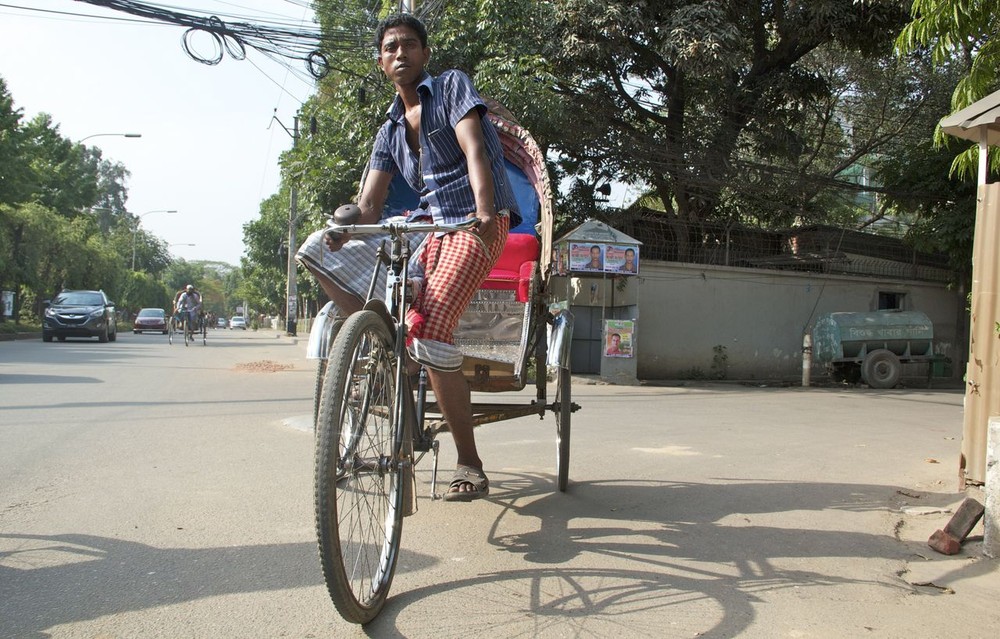
The country has been engulfed in endless political protests. Meanwhile, a demonstration of a different kind took place over a ban on rickshaw drivers wearing a traditional garment that is worn by millions throughout the country.

Crowds of young Bangladeshis filled the streets of Dhaka three weeks ago wearing colorful lungi to protest the ban on the dress in our diplomatic enclave, Baridhara.

Vlad and I witnessed the ban first hand when our favorite rickshaw driver, Babu was pulled over and not allowed into Baridhara because he was wearing a lungi. We fought with the police officer and managed to somehow get him instead. We ended up inviting him for dinner and Vlad donated him some of his clothes which amazingly were the right size.


Anyway, about 400 marchers protested the recent ban on rickshaw drivers from wearing the lungi in Baridhara. Most of them wore the traditional lungi. The peaceful rally was announced on Facebook just days after the chairman of the Baridhara housing association, said only rickshaw pullers wearing trousers would be allowed to work the area.
Lungi are in some circles considered to be worn by the lower class, but is the most commonly worn garment by men in Bangladesh. Even the father of the nation, Sheikh Mujibur Rahman, wore a white lungi often to show his solidarity with the people of his homeland. The ban is even sadder since the average income of a rickshaw-wallah is about $4 a day, excluding rental fees for the rickshaws of around $1 per day.


As the demonstrators marched towards Baridhara chanting "lungi, lungi", they were stopped by dozens of police blocking the entrance with guns and batons in hand. Protesting is not allowed in diplomatic zones, they were reminded by the officers on the scene.


Soccer, my cure of choice against the Dhaka blues

It is a known fact. All the books on expats say it: When you find yourself in a “challenging duty station” (you have to love the nice way of saying that), you need to find your niche, something to do that makes you feel good.

It could be running, biking, baking, volunteering, golf, you name it…For me, filling my days with things to do is never an issue. I am busy with work, kids and wife, parties, a blog… In fact, if anything, I would need more hours in a day. But I still need something to make me feel good and take me out of the house. Well, here it is again : Soccer.

Yes, there is soccer in Dhaka. A handful of fanatics get together and play during 100 degrees weather. Dust is flying everywhere during the dry season and my saliva has a brownish color when I get home. During the wet season I am being told is getting worse because of the mud that takes over the field. Is a wonder I come out of each game feeling so light on my feet and happy!

So, when feeling the Dhaka blues, crawl out of your space and play soccer!

Sunday, April 28, 2013

Man! I Feel Like a Woman!

Ever since we arrived in Dhaka, the gender inequalities in Bangladesh have been obvious. The employment rate, education rate, any statistic in the book points to the gap in opportunities available to men and women.

Women here are covered from head to toe in their salwar kameez and even some women wear a full burqua. On the other side of things, you constantly see men peeing in public and doing whatever they please. But I will write more about that in a separate post.

Cristina's diplomatic card arrived not long time ago and the Government of Bangladesh made sure her role was clearly spelled out on it: "She is the spouse of  Diplomat".

Needless to say Vlad and I still have a good laugh about it.


Friday, April 26, 2013

Roadside tea stalls

The Tea stalls (Chayer Dokan) are such a common sight in Bangladesh and in Dhaka in particular. This is the place the day laborer, the rickshaw puller, the student,  or the garments workers come together.

A small place surrounded (maybe) by a few chair, furnished with kettle, bread, banana, filter water bottle. I see them all the time when I move around the city.

Bangladeshis took to drinking tea from the Brits during their colonial times. Even though is not the same quality as the one grown in Sri Lanka, tea is one of the most exportable items in Bangladesh.

Once it was drunk in the restaurants. But now it is sold in footpath of city area. Why? Because it is cheaper. But how secure or healthy a tea stall on the footpath can be? A tea cup is used many times without proper cleaning. I doubt the quality of filter water too. I can't even look at the baked products sold there.

On a funny note, when we moved to Dhaka, there was an old lady with a tea stall right next to our temporary house. Business was brisk, the customers did not seem to mind everything was cooked right on top of the sewage drain. We would pass by at least once a day and every single time I would notice Cristina fighting a gagging reflex, trying not to throw up. Two weeks later, on her first day on the job, a local employee brought some food from the street for lunch and Cristina was quickly offered some sort of a fried meatball. She bit the bullet and decided to be polite and eat it. Five minutes later, same guy comes back with tea. Flashbacks of the old lady cooking on top of the sewage and courtesy was thrown in the wind :

"Thank you, but I just had my coffee"

I still laugh thinking about the episode :)


A tiny little tea stall on the side of the road. It's actually built on stilts, suspended over the drainage ditch. Once again, they manage to make use of every possible open space in this crowded city.

The Times They Are A-Changin'

Up until today, there has never been serious unrest inside of diplomatic enclave. That means that Gulshan and Baridhara (the so called diplomatic zones) never came under attack. 

But we are now living in different times or like Bob Dylan song goes:

"The times they are a-changin'..."

Angry over the deaths in Savar building collapse, thousands of garment workers vandalized today hundreds of vehicles in different parts of the city, including Gulshan.


Ironically, the vandalism also disrupted supply to different hospitals and clinics in Savar area which are treating the injured victims.

Thursday, April 25, 2013

Give the ambulance the right of way...or maybe not!


As I said before, traffic is bad here. In fact, bad is taken to a new level. Is you against everybody. Fight tooth and nail for your spot. Do not back down. NEVER, EVER, give up an inch. Honk at others even if there is no way in hell they can move one inch. Get on the opposite lane and drive against the incoming traffic. Use the sidewalk if your car is tall enough. But above all, DO NOT, I REPEAT, DO NOT EVER MAKE WAY TO AN AMBULANCE.


I see ambulances stuck in traffic all the time and I see them being cut off all the time. It seems like everyone is voting not to believe there is a real emergency inside of that ambulance. My guess is if it were a real emergency, they would be driving AGAINST TRAFFIC???

So, I am praying none of us will be sick enough to need an ambulance here. I would not want to have to choose between waiting in traffic, like everyone else, (and maybe die) and telling my driver to go against traffic.

"Bondhu (friend), let's just try our luck driving against the traffic. I feel lucky today!" After all, is all about minimizing risk :)

Doctor! Doctor!

The other day, in the morning we found a parked ambulance inside of our apartment complex. Our hearts stopped at its sight and quickly asked the driver what happened. Who is sick?


"No worries, boss, we are just taking your neighbor to the airport. Is a hartal day!"

Dhaka is quickly becoming a city of ambulances. Because they are not (generally) molested on the roads by pickets, suddenly there are tons of them, not all complete with flashing lights but with AMBULANCE or AMBALANCE written all over them. Dacia is telling me that one her classmates owns a big one, no bed in the back, just benches.

Strangely, the "injured" inside look remarkably fit, and there are usually about a dozen of them sitting there with prayer caps on, showing a reserved smile.

Oh well, TIB :)


Some more "good" news from Dhaka

After a terrible start of the week, we got hit with more bad news yesterday.

The nine story Rana Plaza building in Savar (20 miles outside of Dhaka) collapsed like a deck of cards. Around 3,000 workers were working inside of the building on Wednesday when this happened.


Firefighters and soldiers joined volunteers in the effort to locate survivors in the mangled wreckage of concrete and steel. Death toll has easily passed 200 at the time I am writing this, but there are lot of people still trapped inside, so I would not be surprised if we end up with a lot more than that. Trapped workers can still be heard inside the rubble, screaming for help. Local hospitals are overwhelmed with scores of people injured.

Bangladesh has one of the largest garment industries in the world, providing cheap clothing for major Western retailers which benefit from its widespread low-cost labor. The money gained from exporting textiles is the single greatest source of economic growth. Exports of textiles, clothing, and ready-made garments accounted for 80% of Bangladesh’s total exports.

However, the country has chronically poor safety standards, so this came as no surprise. What is somewhat new are the circumstances surrounding the collapse. The building violated any construction codes and the owner illegally added three extra stories to the building. On Tuesday morning, cracks developed on some pillars and a few floors of the building following a jolt, causing panic among the people working there. They rushed out of the building and some even got injured in the process. The industrial police visited the building that day and advised  suspending operations of the factories. The warnings and instructions were all ignored. The owners of the garments closed their factories around Tuesday noon but asked the workers to show up for work the next day. Still shaken by the scare they got the day before, the workers turned up for work yesterday but many were hesitant about getting into their factories. They have been told that some engineers had certified that the building was safe. The factories deduct salaries for three days for any non working day, so people had to go inside. The irony is that Sohel Rana, owner of Rana Plaza, was inside the building when it collapsed. He was rescued and is now on the run.

It is really a catch 22 situation. Western retailers try to keep costs down. Bangladesh is one of the longest lead-time country and a difficult country to work in, so the only way it becomes competitive is by offering the lowest cost. If the factories want to raise prices to make up for rising wages and costs, the buyers will say, "Why do we want to go to Bangladesh if I could go to China, Pakistan, Cambodia etc for a similar price?" That would lead to a lot of people losing their income source.